
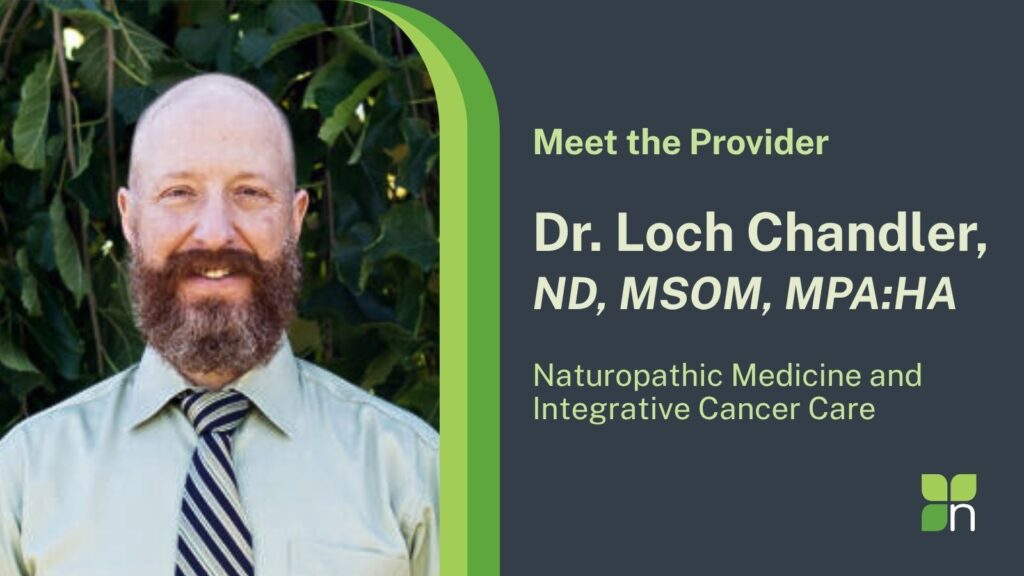
A Career Rooted in Curiosity and Care
Some careers follow a straight path. Others begin with a moment that quietly changes everything.
For Loch Chandler, ND, MSOM, MPA:HA, that moment came during a conversation at age 26. It started with an unexpected discussion during a massage appointment that shifted everything. The therapist shared a personal regret about not finishing naturopathic medical school.
It was the first time Dr. Chandler had ever heard of naturopathic medicine.
That single moment stayed with him. Curious, he looked into it and found a philosophy that immediately resonated, one grounded not only in treating the whole person, identifying the root cause, and supporting the body’s ability to heal, but also in Docere: the role of the physician as teacher and educator, empowering patients with the knowledge to take an active role in their health.
Already equipped with a pre-med degree, within a few months he had applied, been accepted, and started down a path that would define his career.
A Foundation in Science and Whole-Person Care
Dr. Chandler’s early interest in science made medicine a natural direction. But conventional medicine never quite felt like the right fit. At the time, he was seeing firsthand how burnout was affecting physicians, including stories from his father, a hematologist oncologist.
Naturopathic medicine offered something different. It allowed him to stay grounded in science while approaching care in a more comprehensive and human way.
That path deepened when he began studying Chinese medicine, where he learned a more individualized approach to care. Rather than treating every patient the same way, this model looks at patterns, symptoms, and the whole person to guide treatment.
That perspective continues to shape how he practices today.
Training that Shaped His Approach
After graduating in 2001, Dr. Chandler completed a residency with Dr. Dickson Thom, an internationally acclaimed ND known for emphasizing diet and lifestyle as the foundation of care. That experience reinforced a principle he still follows: start with the basics, then build from there.
Nutrition, movement, sleep, and stress all play a role in how patients feel and respond to care. From that foundation, treatment becomes more targeted and personalized.
Over time, his clinical work evolved to focus heavily on supporting patients navigating cancer, alongside general naturopathic care.
A Focus on Supporting Cancer Patients
Today, much of Dr. Chandler’s work centers around integrative oncology.
Rather than replacing conventional treatments, his role is to support patients during their cancer treatment journey.
“I don’t have anything in my wheelhouse that treats cancer itself,” he explains. “I do have a lot of therapies with anti-cancer aspects, but none that have been conventionally studied in randomized double-blind trials. What I can offer is support to help patients get through treatment and feel better while they’re doing it.”
This includes helping patients manage side effects, maintain their strength, and improve their overall quality of life during a difficult time.
Supporting Patients During Treatment
Cancer treatment can be physically and emotionally demanding. Many patients experience side effects that impact daily life, from nausea and fatigue to neuropathy.
Dr. Chandler works closely with patients during this phase, often seeing them regularly so care can be adjusted in real-time. His naturopathic approach is designed not only to ease symptoms, but to help patients stay on track with their treatment plan. By reducing the severity of side effects, these supportive therapies can decrease the likelihood of treatment-limiting complications that might otherwise require dose reductions or breaks in care. They may also help lower the risk of long-term or permanent side effects such as chronic neuropathy.
HIs approach may include:
- Acupuncture to support nausea, pain, and nerve health
- Nutrition and supplement guidance to help manage weight and reduce anemia
- Lifestyle strategies to improve resilience
“I think the biggest thing we can do is help people tolerate their treatment,” he says. “So they’re not as nauseous, not as fatigued, and able to keep going.”
For many patients, this support can make a meaningful difference in how they experience treatment.
Care That Continues After Treatment
Support does not end when treatment does.
After chemotherapy or radiation, patients often enter a new phase that can feel uncertain. Side effects may linger, and many are left wondering what comes next.
Dr. Chandler helps patients transition into this stage with a different focus.
During treatment, care is often more hands-on and symptom-driven. Afterward, it shifts toward long-term health.
“We move away from just managing side effects and start focusing more on diet, exercise, and lifestyle, he says. “Those are some of the most important tools for long-term health.”
This phase is about rebuilding strength, supporting recovery, and helping patients feel more like themselves again.
Learning from Patients
Some of the most important lessons in Dr. Chandler’s career have come directly from patients.
Early on, one patient challenged him to think differently after a standard treatment approach did not work. That experience pushed him to move beyond protocols and develop more individualized care plans.
He has also seen how factors like stress, resilience, and life circumstances can influence outcomes in ways medicine alone cannot control.
Those experiences have shaped a grounded, thoughtful approach to care.
A Grounded Approach to Care
Working with cancer patients can be emotionally demanding, but Dr. Chandler stays focused on what he can control.
“As long as I’m doing my best for each patient, that’s what matters,” he says. “You can’t control every outcome, but you can show up and support them the best you can.”
That mindset allows him to remain present with patients while navigating the realities of serious illness.
What Patients Can Expect
At the NUNM Health Center, Dr. Chandler works with both oncology patients and those seeking general naturopathic support.
His care often includes acupuncture, nutrition guidance, supplements when appropriate, and lifestyle counseling.
Each plan is tailored to the individual with a focus on helping patients feel supported, informed, and cared for at every stage of their health journey.